3.16.2013

How I Became a Political Activist

My membership button from the
organization Annie created to
watch for violations of the laws
created to protect the wild horses:
Wild Horse Organized Assistance

I was what was commonly called 'horse crazy' when I was a little girl.  I loved all things horses.  I loved how they looked, and how they made me feel, and when I could see a real one, I would pet it and smell it and hug it.  I wanted one so bad I could feel it to my core.  One year, after a lot of focus, determination, and hard work, that came true.

But first, I read about them.  Boy, did I.  I was so obsessed for the first several years of my reading life, I would not read about anything else.  When I was around 10 years old, I read a book that was about more than just horses; it was about some very special horses, and they needed help.  Marguerite Henry's prize-winning children's book, Mustang: Wild Spirit of the West.  Through that book, a woman named Velma Johnston became a popular heroine to millions of American children. With clear, innocent vision, we young readers of her book quickly grasped the heart of the issue.  One young reader's letter to Ms. Henry shared:
"It makes me angry and I think that the horses should be allowed to run free. They will soon be like the Buffalo that used to roam the plains of America. Extinct."
I had the same reaction.  I wanted to do something about it!  But what could I do, just a kid?  I didn't know it then, but there would be a way.

Determined to make a difference, Velma Johnston began a grassroots campaign, that involved mostly school children. Young people from all across America sent letters to newspapers and legislators and attracted enormous attention that outraged the public and made them aware of the issue. And, as public attention grew, some of Johnston's critics began to make fun of her and call her Wild Horse Annie. But no matter what her critics did, she continued her fight — and newspapers continued to publish articles about the exploitation of wild horses and burros. Starting back back in January 1959, Nevada Congressman Walter Baring introduced a bill prohibiting the use of motorized vehicles to hunt wild horses and burros on all public lands. The House of Representatives unanimously passed the bill which became known as the Wild Horse Annie Act. The bill became Public Law 86-234 on Sept. 8, 1959. However, this law did not include Annie's recommendation that Congress begin a program to protect wild horses and burros. Public interest and concern continued to increase, and with it came the realization that federal management was needed. In response to public outcry - including the letters from kids like myself, written to President Nixon - the Senate unanimously passed a law on June 19, 1971. It became known as The Wild Free-Roaming Horse and Burro Act of 1971. Wild Horse Annie knew that young people can make a difference, and through this experience, I learned, too.

2.25.2013

Where I Came From

"It's a sad country, but it's the most beautiful God ever made. There's a wildness to it, a richness of colour, a sweetness on the wind you couldn't know unless you'd smelled it. It's a very old land where once heroes and saints and scholars lived and now the memory of those days aches in the colour of the earth, the standing stones, the trees against the sky, the sound of a storm." - Ann Perry

My ethnic background is a mixture of many cultures. My father's was Norwegian and German/Scot/English stock, from his mother and father respectively; my mother's was Irish/English (both parents).

While I did hear about the Norwegian side of things in passing conversation while growing up, my general sense of who I was, was of being Irish. My mother’s family was overwhelmingly Irish, with a wee bit of English thrown in just to keep it interesting.  I grew up with brown bread, strong Canadian tea, roast beef dinners, making do, passionate ‘discussions’, and knowing the value of hard work and faith. Family was important, and that included laying your cards on the table even if feelings got hurt; honesty was prized, and unkind words quickly forgotten. While you might feel like killing someone for a split second, you hugged them the next. Life went on.

While I eventually grew to appreciate my father’s family, learning there was more to my father's family history than I at first had realized, I’ll always think of myself as an Irish girl.

1.19.2013

Bedwetter


One of my oldest memories is of being in a cold metallic crib, crying my eyes out.

I was in a room in the Emerson Hospital, and my Mom had to leave me for awhile.  Dr. Ferry was going to be performing a tonsillectomy on me in the morning.  I was just three years old.

The next day, I recall large people looming over me in a strange room.  I was lying down, and they were coming at me with something round, and telling me don’t be scared.  That just made me more alarmed.  I began breathing faster, through the thing, and it smelled strange.  It was the smell of rubber and ether.  I suddenly felt a huge lurch in my stomach, someone brings a metal pan to my mouth, and I vomit.  Evidently ether often had that effect on patients.  After that, I didn’t remember anything until I woke up later with a sore throat.  The good news was that I could have all the ice cream,  pudding, and popsicles I wanted.  

That was my first time, post-birth, that I was in the hospital as a child, but it wouldn’t be my last.

So many times, more times than I can remember, I had problems that required a doctor or hospitalization when I was growing up.  I had the normal things that many children did at the time - chicken pox, mumps - but I also had an unusual amount of upper and lower respiratory infections, sinus and ear infections, as well as kidney and bladder infections.  

The kidney and bladder infections were frequent and often severe.  My mother was told to cut me back on salt, to not allow me to sit on cold surfaces, to dress me warmly in winter, and to keep my head covered from cold and wind.  I was sometimes on several medicines, including antibiotics.  As my urinary tract problems increased, I had more and more catheterizations to obtain the most sterile urine samples possible to determine the cause and course of treatment.  I once had a dye injected into my bladder and told to not urinate for as long as possible as they observed my bladder when full, with the dye helping them to see it better.  To a child, those  procedures were extremely frightening as well as painful1.

There were times I had long hospitalizations that caused me to be out of school for awhile2.  I received cards wishing me well from my classmates, which cheered me up.  I don’t recall being particularly concerned, my Mom said the doctors kept saying that they didn’t think this was serious, that my organs were functioning well, but just that I was getting infections that caused significant pain.  I remember well the pain, the burning, the urgency, the fevers, and the bed rest.  And then, there was the bedwetting.


I don’t know if my bedwetting was connected in any way to my other problems.  My mother made allowances for it and may have thought so, at least at first.  I was not allowed to drink after supper, in hopes it would curtail the problem, but it didn’t.  As I grew older, however, there were many times, especially in the middle of the night when she was changing sheets, that she would mutter about me being lazy about getting up to use the pot3.  I would tell her that I wasn’t.  In my own mind, there was nothing more that I’d rather do than get up.  I hated it far worse than she believed I did.  

When I was growing up, all the way through high school, I slept very sound and very deep.  Nothing would wake me up.  I dreamt profusely, dreams-worthy-of-the-Twilight-Zone dreams.  The only thing that (sometimes) woke me was a cold, wet bed.  The routine went like this:  I’d wake up in a swamped bed, everything wet.  I’d call for Mom.  She would come and I couldn’t look at her, ashamed and wishing more than anything that I didn’t have to call her.  When I got old enough, I changed the sheets myself4, but I knew she was often woke up by me opening the old dresser drawers which squeaked at every pull.  The old house’s floors creaked, and every sound seemed magnified in the night.  

The doctors' predictions turned out to be right.  Some time when I was around 11 years old,  I stopped wetting the bed.  All my fears of never being able to go to camp, or stay over at a friend's house, went away, and I was excited to expand my universe, which I inevitably did.  But I never forgot the sicknesses of my childhood.  In a way, although there was a brief respite, they have followed me into adulthood.  But as I often say, that, that is another story.


__________________________

1 - No test or procedure, at any hospital, during all the years I was afflicted, ever could give my Mother a definitive reason for my multiple kidney and bladder infections.

2 - At one point, when I was about 10 years old, my physician referred me to specialists at the Victoria Hospital in Winnipeg.   They had a whole floor just for children, a pediatric section.  There, I met the first black person I had seen - a girl my own age.  I felt strange meeting a person so different from myself, but at the same time excited.  This was the late 1960s, and I had been watching the news on TV, and knew that the civil rights movement was happening.  I believed in it, as young as I was, and wanted to learn more.  Thus, she and I became friends in the time I was there, and I was sad to part when the time came.  It was also during this time that my Mom tried to soften the separation by giving me a very special gift, a doll I named Sally. She and I became very good friends.

3 - “The Pot” was what our family called a chamber pot. We used took one upstairs every night to use, and it was my responsibility as a child to prepare it with a little water and bleach, and take it up when we went to bed, and dump it and rinse it every morning.


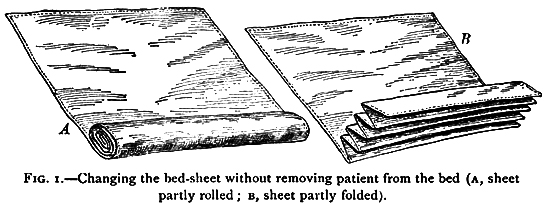
4 - My Mom used old rubber draw sheets from my Grandma Fitzpatrick’s old maternity home days.  On top of that she doubled up a white top sheet and covered that around the middle of the bed.  That way we didn’t have to change the bottom sheet itself.

1.09.2013

Last Mittens


Sleepovers at Grandma's house. Asleep in the big bed downstairs with Grandma. The one she used to share with Grandpa. The one he died in. Snuggling close to her and loving how her skin smells. Falling asleep feeling happy and safe. Next morning, Grandma makes me milk toast sprinkled with brown sugar, served with hot cocoa...

Among my Grandma Fitzpatrick's many talents, was handiwork. She sewed clothes.  She made pillow cases, dresser scarves, and dish towels, then embroidered them.  And she knitted.

The photos here show some of the last work she did.  She not only knitted, but she repaired what she knitted.  Usually she'd darn them with yarn of the same color and you'd never know they had been repaired.  On this example at left, she had to use what she had on-hand.  We didn't care.  As long as it kept our hands warm!

The pair on the bottom were the last ones she made.  Those who know their knitting will notice she did not have as steady a hand, and a stitch or two may have been dropped.  It was harder for her to see, and her hands were not as nimble as they once were due to arthritis.

No one has ever worn the green mittens, and no one ever will, if I have my way about it.  I have kept them - and a set of dish towels, several sets of pillow cases tucked away, tangible evidence of a woman whose hands made them.  I can look at them, and touch them, and along with memories, the love we had between us comes flooding back.  I will never forget you, Grandma.

12.06.2012

Home Remedies

Mustard Plaster Recipe: This is made of different strengths, depending upon the length of time it is desired to keep it on and the sensitiveness of the skin.

1. Equal parts of mustard and flour.
2. One of mustard and two of flour.
3. One of mustard and three or four of flour. White of an egg added makes it better and not so blistering.

A paste is made with warm water and spread between the layers of muslin and left on no longer than ten minutes. When the skin is red remove the plaster. This is used when you wish a quick counter-irritation.
The above recipe for a mustard plaster - a very commonly used home remedy in the early to mid 20th century - was taken from the medical volume of The People's Home Library: A Library of Three Practical Books; sold door-to-door by salesmen, published by the R.C. Barnum company, "...a well-known subscription book company at that time."  Many is the time I watched my mother make mustard plasters, sometimes for my father, and sometimes even for me (and this was in the 1960s yet...)  When I was small, I tended towards chestiness, and had more than my share of terrible colds, flu, chicken pox, measles, not to mention ear and tooth aches.  My mother nursed me very well through them all, with help from my grandmother who lived nearby, this book, her own common sense, and experience.  It may have been old-hat by then, but old tech doesn't mean irrelevant or outdated.  Sometimes the old cures are very effective.

My Grandma bought a 1920 edition of the first in the series, called The People's Home Medical Book, by T.J. Ritter, MD. It described Dr. Ritter as a "...Graduate of both the allopathic and homeopathic schools; formerly asst. to the Chair of the Theory and Practice of Medicine, Michigan State University, Ann Arbor, Mich."

My Mother grew up under the care of Grandma using the advice of that book, together with her own common sense. In turn, my own family, including myself, came under it's influence in due time. Where some may have learned about human anatomy from National Geographic or girlie magazines, I learned from the People's Home Library.1

As I raised my own children, I didn't have the book to refer to, but I remembered my mother's examples, and carried on the tradition of common sense home nursing care, and not running to a doctor every time my children sneezed.  I provided simple but effective remedies like gargling with warm salt water when there was a sore throat, providing a comforting (and chest/nose opening) warm 'steamer' (aka vaporizer) at night when they slept, had oil of cloves on hand for tooth aches and ear aches, etc.

1 - I also learned some interesting facts of life from my Mom's Bible, which was illustrated in color with reproductions of famous painter's renditions of scenes from the Bible. I must admit that I was, even at a tender age, very appreciative of the curve of the nearly nude derriere of Samson as he pushed the mill stone around...but that's another topic altogether!

11.03.2012

The Art of Visiting

My Grandma Fitzpatrick, visiting with relatives in the family homestead (circa 1970).
When I was growing up, there was something called visiting.

Visiting was when you walked down the road, or jumped in your car for a drive to nowhere in particular, and you ended up at someone's home. You didn't call ahead - you didn't have to.  No one cared if you did, and most likely they were home and excited to see you.  You were welcomed into the home, and before you knew it, you were sharing the latest news, telling clean, corny jokes laughing like a fool, and loving every minute of it.

And you never left without being fed. Sometimes an entire meal, but most definitely at least bars or cake, and the ever present coffee. The pace of life was different then. People weren't so much in a hurry, and they took the time to ask after you. How's your family? How's your garden coming along? I can't believe how big your boy is now; seems like yesterday he was just a baby. Did you hear...?

Life was not as regimented as now.  There was regularity, a rhythm, to be sure.  But it felt more organic.  I suppose it could just be that I was a child, and I'm now romanticizing it through the nostalgic lens of memory.  But I don't think so.  I think it was a better time.

10.31.2012

Dad & the CCC's


My Dad grew up on a farm in northwestern Minnesota.  He only went through 8th grade, which wasn't unusual back then.  When you were part of a farm family back in the 1930s, every hand was needed to make it run.  Farming was a labor-intensive job back then, with many farms, including my Grandfather's, still using horses for some of the work right alongside machinery.

Dad, 1938
When Dad got to be around 19, he went further north to a town called St. Vincent, where his Uncle Gail and Aunt Liza ran Short's Cafe.  It was actually part soda fountain/ice cream counter, part restaurant, part saloon, and - if rumors were true (and I have heard stories from people who knew, that they were), part backroom gambling hall.  He went there to work in his uncle's establishment and there met my mother (age 16), one of the village girls stopping by for a soda.  While the rest of that story, as they say, is history, Dad had more personal history to forge before he and Mom were married and walked the rest of their lives together.

Dad's discharge papers from the CCCs.
Sometime in 1940, Dad decided to check out the CCC, or Civilian Conservation Corps.  The CCC was one of the New Deal agencies, offering work programs to young men seeking employment during the Great Depression.  To put it simply, the program provided training/experience for the young men, and much needed works projects for the public - a win-win for everyone at the time.

Dad worked in Company 718, stationed near Big Fork, Minnesota, which is in the north central part of the state, not far from the 'arrowhead' region.  His company was part of a group that worked in the Pine Island State Forest.

Dad's time with the CCCs were cut short, when he was notified to report for medical examination, the precursor to induction into the military.  It was then only a matter of time before he was called up for training, active duty, and sent overseas to fight.  But that, that is another story...
Call to Duty